

If you rely on glasses or contact lenses for everyday tasks such as driving, work or sport, you may be looking into laser eye surgery and wondering how PRK vs SMILE compares. Both procedures reshape the cornea without cutting a flap, but they reach the tissue in different ways, and that difference affects recovery time, comfort and suitability.
Both are forms of laser vision correction used to treat short-sightedness and astigmatism. This guide explains how each procedure works, how recovery compares, how each affects the eye’s surface and which factors guide the choice between them.
Quick Overview
- PRK and SMILE are both laser procedures that change the shape of the cornea so light focuses more accurately inside the eye.
- PRK removes the surface layer of the cornea before an excimer laser reshapes it, while SMILE removes a thin disc of tissue through a small incision.
- Corneal thickness, prescription, tear film and lifestyle all influence which procedure suits an eye.
- A full assessment, including corneal measurements, is the step that guides the choice.
The sections below cover each point in more detail.
What Is the Difference Between PRK and SMILE?
The main difference is how each procedure reaches the corneal tissue. PRK, or photorefractive keratectomy, treats the corneal surface after the outer layer is removed. SMILE, or small incision lenticule extraction, works inside the cornea and leaves most of the surface in place.
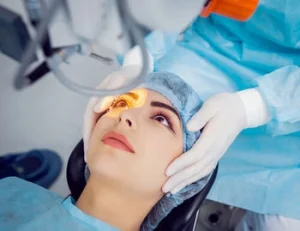 In the PRK procedure, the outer layer of the cornea is softened with a solution and gently removed. An excimer laser then reshapes the exposed surface, and the surface layer grows back over the following days.
In the SMILE procedure, a femtosecond laser shapes a thin disc of corneal tissue within the cornea. Your eye surgeon removes that disc through an opening a few millimetres long, and the change in shape corrects the prescription. SMILE eye surgery is described as minimally invasive because the front of the cornea is largely left undisturbed.
LASIK eye surgery, or laser-assisted in situ keratomileusis, involves flap creation. LASIK creates a thin corneal flap that is lifted before the laser treats the deeper layer of the cornea. LASIK and SMILE both use a femtosecond laser, but SMILE has no small flap to lift, and PRK uses no flap at all.
How Does Recovery Time Compare in PRK vs SMILE?
Vision usually settles sooner after SMILE than after PRK. After SMILE, vision typically improves within a few days, while PRK usually needs at least a week of rest before normal activities resume. Most patients have improved vision after laser eye surgery, and vision can keep stabilising for up to six months.
PRK takes longer because the surface layer has to regrow first. PRK is associated with more discomfort in the first days and a slower return to clear vision. A temporary corneal haze can also develop in a small number of eyes after PRK, and it usually clears as healing continues.
Which Procedure Suits Thin Corneas or Contact Sports?
PRK suits thinner corneas and eyes with a higher risk of injury, and for low short-sightedness it gives visual results comparable to SMILE at six months. This can make PRK worth considering if you play contact sports, lead an active lifestyle or work in a role where your eyes could be knocked.
Both procedures remove corneal tissue, and enough tissue must remain after treatment for the cornea to stay stable. Corneal thickness is measured during your assessment for this reason. This is why PRK can be the right procedure for a thin cornea, even though it does not offer a fast recovery.
Do PRK and SMILE Cause Dry Eyes?
Both procedures can cause dry eyes for a period, because the corneal nerves that help regulate tears are affected during treatment. Dryness affects many patients after corneal laser surgery: 41% of treated eyes had symptoms at two months, with a higher rate after surface procedures such as PRK than after LASIK. Dry eye symptom scores also tend to stay lower after SMILE than after PRK in the 18 months after surgery.
Tear film quality before surgery matters too, as eyes with a less stable tear film are more likely to develop dryness afterwards. Existing dryness is usually treated before laser eye surgery is planned, because eye surface problems can delay treatment.
Who May Not Be Suited to PRK or SMILE?
 Not everyone is suited to laser eye surgery, and several factors decide whether PRK, SMILE or neither is an option for you:
- Corneal shape: An irregular or cone-shaped cornea, such as keratoconus, can rule out laser procedures.
- Prescription range: Some prescriptions fall outside the range that laser surgery can treat, and a lens-based option such as ICL or refractive lens exchange may be discussed instead.
- General health: Diabetes, autoimmune conditions, pregnancy and breastfeeding can delay or rule out treatment.
Individual outcomes vary, and both procedures aim to reduce dependence on glasses and contact lenses rather than remove it in every situation.
A Considered Approach to PRK vs SMILE
The choice between PRK and SMILE depends on your corneal thickness, your prescription and the health of your eye’s surface, and these can only be measured at a full assessment. Dr Edward Roufail is an ophthalmologist who performs LASIK, SMILE and PRK, so each option can be weighed against your own measurements. At your consultation, your vision and prescription are tested, and scans of your eyes may be taken. Dr Roufail then explains whether either procedure suits your eyes and what recovery would involve. To arrange a laser vision correction assessment, please call us on (03) 9071 0180.
Frequently Asked Questions
Could I need a second procedure after PRK or SMILE?
Sometimes. The first treatment can slightly over-correct or under-correct your prescription, or some of it can return over time, and a second enhancement procedure may then be needed. Enhancements are uncommon, and they tend to be needed more often after PRK than after SMILE.
In PRK vs SMILE, which one can treat long-sightedness?
PRK can treat long-sightedness, because the excimer laser can steepen the centre of the cornea. SMILE is used mainly for short-sightedness and myopic astigmatism, so PRK or LASIK may be considered instead if you are long-sighted.
Will I need reading glasses after PRK or SMILE?
Reading glasses may still be needed later, because presbyopia usually begins in your 40s, when the eye’s natural lens becomes less flexible. Standard PRK or SMILE does not usually correct this change. If you are finding close work harder, we can discuss options such as Presbyond, a blended vision laser procedure.
Do I need to stop wearing contact lenses before PRK or SMILE?
Yes. You will usually be asked to stop wearing contact lenses for a period before your surgery. Your eye surgeon will tell you how long to leave them out.
How old do I need to be for PRK or SMILE?
Laser eye surgery is usually considered from 20 years of age. Your prescription should also have been stable for at least two years, because surgery on an eye that is still changing can increase the risks.
Any surgical or invasive procedure carries risks. Before proceeding, you should seek a second opinion from an appropriately qualified health practitioner.
References
https://doaj.org/article/238e2e79e4c649df9a62df91e9ee0e12
https://gjyk.ijournals.cn/gjyken/article/abstract/20230415