

You had surgery to see more clearly, and for the first stretch afterwards you see less clearly than you did with glasses.
Blurry vision after laser eye surgery is part of the normal healing process, and in the vast majority of cases it typically resolves. What varies is how long vision takes to settle, and which of several causes is behind it in your eye.
Quick Overview
- Some blurriness in the first days is expected, because the eye’s surface is healing and the visual system is adjusting to a new focus.
- Dry eyes are the most common reason vision remains blurry in the weeks afterwards, and blurry vision after LASIK often traces back to the tear film.
- Vision can take up to six months to fully stabilise, and fluctuations along the way are part of the process.
- Vision that worsens, or new pain, is a different matter and needs prompt review.
The sections below cover why blurriness happens, how dry eyes affect vision clarity, how long the recovery takes, other causes worth ruling out, and what helps.
Why vision is blurry straight after surgery
Laser eye surgery reshapes the cornea, the clear front surface of the eye, to correct refractive errors. In the LASIK procedure (laser-assisted in situ keratomileusis), a thin corneal flap is lifted, the laser reshapes the tissue beneath, and the flap is laid back down. In PRK (photorefractive keratectomy), the surface layer is removed instead of lifted.
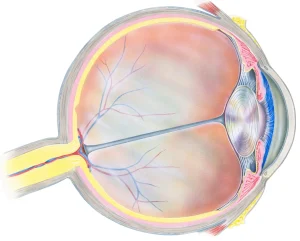 Either way, the cornea has been altered and is healing. Light passing through a healing surface scatters slightly, which shows up as haze or blurry eyes instead of sharp vision.
The visual system is also adjusting. Your brain has spent years interpreting images through a particular prescription, and it needs time to adapt to the new one. Vision clarity improves as that adaptation happens. That adjustment is a real part of the recovery, and it is why vision can feel unsteady before it feels settled.
Most patients experience improved vision within the first few days after LASIK surgery, and temporary blurriness in that window is completely normal. Surface procedures take longer, because the epithelium has to regrow before vision can begin to clear.
Dry eyes and blurry vision
Patients who experience blurry vision that fluctuates in the weeks after LASIK eye surgery should consider dryness first. Dry eye disease is the most common complication after LASIK, and almost all patients develop some degree of dryness in the post-operative period.
The mechanism is straightforward. Creating a corneal flap cuts nerves that run through the cornea, and those nerves control tear production and the blink reflex. With reduced signalling, the eye makes fewer tears and blinks less often, so the tear film covering the eye’s surface breaks up faster.
That tear film is part of your optical system. When it is unstable, vision blurs and clears as you blink, which is why many patients describe visual disturbances that change through the day and worsen with screen use, air conditioning or reading.
Corneal sensitivity drops noticeably for around three months after LASIK, and the nerves regenerate over roughly three to six months. For most patients, the dryness improves along the same timeline, and only a small number experience it as a long-term problem.
How long does blurry vision last?
There is no single answer, because it depends on the procedure and on your eyes. What can be said is that vision changes are expected during the first few weeks, and that stabilising takes longer than most patients anticipate.
Dry eye and light sensitivity are the problems that show up earliest, usually in the opening weeks, and they tend to pass within a few days. Vision itself is slower, and stabilising can take as long as six months.
The early days bring the most obvious change after LASIK. The first month brings steady gains with fluctuations along the way. From then on, changes become small enough that you stop noticing them.
Mild blurriness that comes and goes across that period is typically temporary. What matters is whether it is improving, and vision that gets better week on week is behaving as expected.
Other causes worth ruling out
Not all blurred vision after refractive surgery is dryness or healing. Several other explanations exist, and each is managed differently.
A residual refractive error is the most common. Laser-assisted vision correction is precise but not perfect, and some patients are left slightly under-corrected or over-corrected. Where this persists after healing, further treatment can be considered once the eye is stable.
Flap problems are uncommon and specific to LASIK. A corneal flap that has shifted or wrinkled affects vision immediately and needs attention quickly, which is one reason rubbing the eye is discouraged so firmly in the early weeks.
Regression is a slower process, in which some of the original prescription returns over months or years. Some patients find they need glasses or contact lenses again for certain tasks, particularly distance vision at night. An examination will show whether the cornea has changed shape or whether something else is responsible.
Unrelated eye conditions matter too. Cataract and macular degeneration cause vision problems that have nothing to do with your previous surgery, and both become more likely with age. If clear vision was achieved and then declined years later, these are among the first things checked, and cataract surgery is often the answer.
What helps while your eyes heal
Following your post-operative care instructions does more for the outcome than anything else, and the eye drops are the central part of that.
Medicated eye drops are prescribed to control inflammation and prevent infection, and they run on a set schedule for a set period. Preservative-free artificial tears sit alongside them and can be used far more often, since they contain nothing that builds up on the eye’s surface.
Beyond the drops, a few practical points apply. Do not rub your eyes at any point in the recovery. Avoid contact sports and anything that risks a knock to the eye. Keep eye makeup away until you are cleared for it. Blink deliberately during screen work.
Follow-up appointments exist to track this. Your surgeon checks how the cornea is healing, measures whether the correction has landed where it should, and adjusts the drop schedule based on what the eye is doing.
When to contact the clinic
 Most blurriness needs patience. Some needs assessment.
Addressing concerns early gives your surgeon more to work with. Contact the clinic promptly if vision that has been improving starts getting worse, if you develop pain that increases instead of settling, or if you notice increasing redness or discharge. Sudden vision loss, flashes of light or a shower of new floaters need same-day attention, since these point to problems at the back of the eye unconnected to the corneal surgery.
If blurred vision continues past several weeks without improving, that is worth raising too, even when nothing hurts. Dryness and a small residual error are both common explanations, and both are easier to address once identified.
Talk to Dr Edward Roufail about your vision
Blurred vision has many causes, and separating normal healing from something that needs treatment takes an examination, not a guess. Dr Edward Roufail is a vitreoretinal, cataract and refractive surgeon who examines the cornea and the retina, identifies what is behind a change in vision, and explains what can be done about it. To arrange an appointment, please call us on (03) 9071 0180.
Frequently Asked Questions
Is it normal for one eye to clear faster than the other after laser eye surgery?
Yes. Eyes rarely heal at the same pace, and a difference of days or weeks between them is common. It can be unsettling while it lasts, because the mismatch itself makes focusing harder. Mention it at your follow-up appointment so both eyes are checked.
When can I drive after laser eye surgery?
Not until you meet the legal vision standard and your surgeon has confirmed you are safe to. This is usually a matter of days after LASIK, though it takes longer after surface procedures. Night driving often takes longer again, because glare and halos are more noticeable in low light.
Will I still need reading glasses after laser eye surgery?
Probably, from around your mid-forties. Laser eye surgery corrects the prescription you have at the time, and it does not prevent the age-related change that makes close focus harder. This is separate from regression, and having realistic expectations about it before surgery is worth the conversation.
Does screen work slow down healing after laser eye surgery?
It does not damage anything, though it makes symptoms more noticeable. Blink rate drops during concentrated screen use, the tear film destabilises, and vision blurs as a result. Frequent artificial tears and regular breaks make a bigger difference than avoiding screens entirely.
My vision was sharp the day after surgery and is blurrier now. Is that normal?
It is one of the more common concerns raised at early follow-ups. Vision often peaks soon after LASIK refractive surgery, then dips as the healing response and dryness set in, before improving again. An initial consultation covers this pattern, since no procedure can promise a smooth line of improvement. Tell your surgeon if the dip is steep or lasting.
Any surgical or invasive procedure carries risks. Before proceeding, you should seek a second opinion from an appropriately qualified health practitioner.
References
https://www.mayoclinic.org/tests-procedures/lasik-eye-surgery/about/pac-20384774
https://my.clevelandclinic.org/health/treatments/21805-lasik-eye-surgery

Are you considering laser eye surgery to achieve better vision and break free from the chains of glasses and contact Read more
