

If you or a family member has been diagnosed with macular degeneration, one of the first questions is usually whether a new pair of glasses will help. Searches for macular degeneration glasses return everything from ordinary reading spectacles to head-mounted electronic screens, and the differences between them are rarely explained.
Understanding what each category actually does, and what none of them can do, makes the conversation with your eye care team much easier. It also helps you avoid spending money on a device that was never going to suit your vision. In this blog post, we cover why standard glasses behave the way they do with this condition, what the various aids are, what the research shows, and where to begin.
Quick Overview
- Standard prescription glasses cannot correct the vision loss caused by macular degeneration, because the damage is in the retina rather than in how light is focused.
- The term macular degeneration glasses usually refers to low vision aids, which enlarge, brighten or reposition an image rather than sharpen it.
- Options range from extra strong reading glasses and magnifiers through to video magnifiers and wearable electronic devices.
- A low vision assessment is the step that matches a particular aid to your own vision and your own daily tasks.
We will start with why the usual answer to blurred vision does not apply here, because the rest follows from that.
Why Ordinary Glasses Cannot Correct Macular Degeneration
Glasses work by bending light so that it lands in focus on the retina, the light-sensing layer at the back of your eye. They correct where the light arrives. They cannot repair the surface it arrives on.
Macular degeneration affects the macula, the small central area of the retina packed with the light-sensing cells responsible for fine detail. When those cells are damaged, the image reaching your brain from the centre of your vision is incomplete, however precisely the light has been focused. A stronger prescription cannot replace what is missing.
 The common symptoms follow from the same anatomy. Straight lines such as door frames or lines of text begin to look wavy or bent. A blurred or dark spot appears near the centre of what you are looking at, sometimes described as a blind spot. Faces become harder to recognise even when you can still see a person’s outline.
This is why an updated prescription often makes less difference than expected after a diagnosis of macular degeneration. The glasses are doing their job correctly. That job is simply not the one that needs doing.
The anatomy also explains why help is available. Macular degeneration affects central vision, while peripheral vision, the vision around the edges, usually remains intact. Nearly every low vision aid is designed around that distinction. This applies to both forms of the eye disease: dry macular degeneration, where the cells of the macula thin gradually, and wet macular degeneration, where new and fragile blood vessels grow beneath the retina and leak. Both produce central vision loss rather than a general dimming.
What Does the Term Macular Degeneration Glasses Actually Mean?
There is no single product sold as macular degeneration glasses. The phrase covers a broad group of low vision aids, and what separates them is what each one does to the image.
Ordinary prescription lenses sharpen an image. Low vision aids take a different approach. They may enlarge it, brighten it, increase the contrast between light and dark, or shift it sideways onto a healthier part of the retina. None of them restores normal vision, and any accurate description of them begins there. What they do is help you make fuller use of the vision you still have.
That difference explains why these aids are matched to tasks rather than to the diagnosis. A device that makes a medicine label readable may be no help at all for recognising a face across a room. It is common for one person to use several different aids.
Which Low Vision Glasses and Optical Aids Are Available?
Spectacle-based aids are the closest match to what the search term suggests. They are worn on the face, they are prescribed, and they magnify.
- Extra strong reading glasses. High-powered reading spectacles, considerably stronger than a standard prescription. The trade-off is that print has to be held closer, because higher magnification brings the comfortable focal point nearer to the eye.
- Spectacle-mounted magnifiers. A magnifying lens fitted to the front of your own glasses, which leaves both hands free for the task.
- Bioptic telescopic glasses. Small telescopes built into or mounted onto a lens. Guidance from a retinal ophthalmologist on which optical aids suit central vision loss describes these as working like binoculars, helping you make out detail such as signage or a face across a room. They are sometimes called special prescription binoculars, and are used for a specific seated activity such as watching TV rather than for walking about.
- Prismatic glasses. Lenses containing a prism, a wedge of glass that redirects light so the image falls on the retina beside the damaged area rather than on top of it. The same guidance notes that these can assist with reading, writing and looking at photographs.
These are prescription optical systems, measured and fitted rather than chosen off a shelf, and lens quality matters as much as lens power. One caution on prismatic glasses: a randomised trial included in the research discussed below found no reading advantage over conventional spectacles, so whether they suit a particular eye is a question for assessment.
How Magnifiers and Video Magnifiers Work
Magnification is the longest-established approach in low vision, and the equipment ranges from a simple lens to a desktop screen.
Low vision magnifiers, whether handheld, on a stand or clipped to your glasses, suit short periods of reading such as a price tag, a bill, or the dial on a microwave. Many include a light, because extra illumination on the page often contributes as much as the magnification.
Electronic video magnifiers work differently. They pair a camera and TV screen or monitor, so the magnified image of the page appears in front of you, an arrangement descended from earlier closed circuit television reading machines. The advantage of this kind of low vision device over an optical lens is field of view, so longer stretches of text remain manageable.
Contrast is adjustable at the press of a button, and multiple view modes such as white-on-black are usually available. Desktop video magnifiers handle books and craft projects. Handheld versions with a small screen offer less screen area in exchange for portability. A tablet camera can perform a similar function, which is worth knowing before making a purchase.
Do Filter Lenses Help With Glare and Light Sensitivity?
Glare and light sensitivity are common with macular degeneration, and they are the reason tinted filter lenses come up so often.
Filter lenses are tinted spectacles that block particular wavelengths of light. The aim is to reduce glare and improve contrast, which is a different goal from magnification. They also block UV rays, which supports general eye health regardless of your macula.
The research on tinted filters in macular degeneration is limited, and the results have been mixed, so no single tint has emerged as suitable for everyone. Amber and yellow tints are commonly trialled for indoor contrast, and darker brown or grey lenses for outdoors. Because the response varies between individuals, trialling a few tints in the conditions you find difficult is a sensible approach before committing to a pair.
What Does the Research Say About Low Vision Aids?
Low vision aids and the training that accompanies them do produce measurable improvements; the size of the improvement varies considerably, and the quality of the underlying evidence is limited.
A 2025 systematic review examining how much low vision aids help reading pooled 33 studies covering 2,611 participants with macular degeneration. Average reading speed rose from 58 words per minute before rehabilitation to 74 words per minute afterwards. The largest single improvement came from eccentric viewing training, which teaches you to look slightly to one side of what you want to see so the image lands on the undamaged retina. In one study within that review, this raised reading speed by around 59 words per minute.
Three further findings are worth knowing. When participants using aids were compared with a control group rather than with their own earlier reading speed, the difference was not statistically significant. Not every device helped: one electronic head-mounted device was associated with a reduction in reading speed of about 15 words per minute. And the reviewers rated the certainty of the overall evidence as limited, because many of the underlying studies carried a high risk of bias.
This does not mean aids are not worthwhile. It does mean expectations should be realistic, and that an aid which works well for one person may not work for another.
Where to Start: A Low Vision Assessment
Measurement comes before purchase. An aid that is too strong is as unhelpful as one that is too weak, because magnification has to be matched both to your measured vision and to the distance you want to work at.
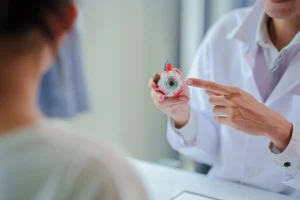 A low vision assessment is carried out by a low vision service or provider rather than in an ophthalmology consulting room. The assessor measures the visual acuity and contrast sensitivity you retain, grades the degree of visual impairment, and asks what you are trying to do, whether that is reading music, sewing, or seeing the score on the television. Aids are then matched to those tasks. Training is included, because several of these devices take practice before they become useful. Guidance on what a low vision assessment involves also covers the wider category of daily living aids, from kitchen scales to large-print playing cards and tactile labels.
Two changes at home are worth making regardless. Improve the lighting where you read, using a directed desk or floor lamp rather than a dim overhead globe. And if you have been given an Amsler grid, use it, checking each eye separately for grid lines that appear wavy or bent, or for a dark spot where there was not one before. Report either finding promptly to your eye doctor rather than waiting for a scheduled visit.
Book a Macular Degeneration Assessment at Our Clinic
Aids help you work around the vision you have, but they do nothing about the condition causing the change, so the two need separate attention. That matters especially with wet macular degeneration, where new blood vessels grow beneath the retina and vision can shift over weeks rather than years, so sudden distortion or a new dark patch warrants prompt review rather than a trip to the optometrist for a new prescription.
Dr Edward Roufail is an ophthalmologist with subspecialty training in medical and surgical retina, and he assesses and manages age-related macular degeneration using retinal imaging, intravitreal injections and retinal laser where appropriate. Family history, smoking and diet are all relevant, so whether quitting smoking or taking nutritional supplements applies to your stage of the condition is worth asking about directly, alongside any change in your central vision. To arrange a consultation at our eye clinic, please call us on (03) 9071 0180.
Frequently Asked Questions
Are there glasses that help specifically with watching television?
Yes. Head-mounted magnifying spectacles are made for this purpose, and this kind of wearable device enlarges the apparent size of the TV screen while leaving your hands free. Each lens can usually be focused separately, and they are intended for seated viewing rather than moving around. If you only want to watch television, sitting closer to the screen achieves something similar at no cost, and is worth trying first.
Can I use more than one low vision aid at the same time?
Yes, and it is a common arrangement. A typical combination might be extra strong reading glasses for short bursts of print, a video magnifier for anything longer, and a tinted lens for going outdoors. Because aids are matched to tasks rather than to the condition, there is no need to settle on a single device.
How long does it take to get used to a low vision aid?
Longer than a new pair of ordinary glasses, and that is expected rather than a sign the device is unsuitable. Higher magnification narrows the field of view, so you see less at once and have to move the page or the device more often. Low vision services generally build training into the fitting for this reason.
Do low vision aids work the same for dry and wet macular degeneration?
An aid responds to the vision you have rather than to the diagnosis behind it, so the pattern and extent of the loss matters more than the type. What does differ is timing. Wet macular degeneration can change vision quickly, which means an aid selected this month may need reviewing sooner than expected.
Will I be able to keep driving with macular degeneration?
That depends on the vision you retain rather than on the diagnosis alone, and it requires formal measurement rather than self-assessment. Central vision is what number plates and road signs rely on, so it is often affected earlier than your general awareness of the road. Raise it directly at your next appointment so it can be measured properly.
Can I buy low vision glasses online without an assessment?
You can, though the risk of choosing an unsuitable magnification is high. The strength has to match your measured vision and your working distance, and neither figure is something you can estimate at home. Having the assessment first generally works out both cheaper and quicker than returning devices that do not suit.
Any surgical or invasive procedure carries risks. Before proceeding, you should seek a second opinion from an appropriately qualified health practitioner.
References
https://www.medicalnewstoday.com/articles/macular-degeneration-glasses
https://www.aihw.gov.au/reports/eye-health/eye-health/contents/about

Maintaining optimal eye health is necessary for overall well-being. However, many people are unsure when to see an ophthalmologist and Read more

If you're tired of wearing glasses or contact lenses every day, it's natural to look into options for long-term vision Read more

If you're exploring ways to enhance your vision, whether due to cataracts or other vision concerns, you may have come Read more

Have you ever woken up and noticed blurry vision in one eye? Or perhaps your vision in one eye suddenly Read more