

LASIK surgery reshapes your cornea, the clear dome at the front of your eye, to correct your vision. In rare cases, the cornea responds to this differently than expected. It starts to bulge and thin over time. This is called post-LASIK ectasia, and it is one of the more serious complications of laser eye surgery.
This guide explains why corneal ectasia happens after LASIK, who is more likely to develop it, and what treatment generally involves.
Quick Overview
- Post-LASIK ectasia is a rare condition where the cornea progressively thins and bulges forward after LASIK surgery.
- A thin cornea before surgery, abnormal corneal topography, and a family history of keratoconus all raise the risk.
- Early signs include blurred or double vision, increased glare, and a gradual drop in uncorrected visual acuity.
- Treatment ranges from contact lenses in mild cases, through corneal cross-linking to stop progression, to corneal transplant surgery in more advanced cases.
Below, we explain what causes this condition, the warning signs to watch for, and the treatment path your ophthalmologist may recommend.
Why the Cornea Can Become Unstable After LASIK
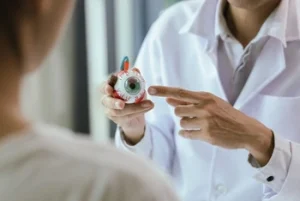 LASIK surgery, known in full as laser-assisted in situ keratomileusis, is commonly used to correct myopia and works by removing a thin layer of corneal tissue to reshape the eye. This makes the cornea slightly thinner than before.
In most people, the cornea stays strong and stable afterwards. In a small number of people, it does not. The cornea cannot hold its shape under normal eye pressure, so it starts to steepen and thin gradually, usually over months to years. This thinning and bulging is corneal ectasia, one of the more serious potential complications of LASIK.
This condition is closely related to keratoconus, which develops in the same way but without any surgery involved. The end result looks similar in both cases: the cornea becomes irregular, and vision becomes increasingly blurred and distorted.
What Raises the Risk of Developing Ectasia
Not every LASIK patient faces the same level of risk. Your eye surgeon will assess several specific risk factors before recommending the procedure, because some corneas are simply more vulnerable to this kind of change.
A thin cornea before surgery is one of the clearest warning signs. If there is not enough corneal thickness to safely remove tissue and still leave a strong, stable base, the risk of post-LASIK ectasia goes up. This is a well-documented concern in ophthalmology, and exactly what pre-surgery scans are designed to identify. Abnormal topography, meaning an irregular corneal shape detected during pre-surgery scans, is another important warning sign. One specific pattern, called inferior steepening, is particularly associated with higher risk.
Research confirms that deep ablation raises ectasia risk significantly, alongside thin corneas and pre-existing topographic abnormalities. A family history of keratoconus also matters, since the underlying corneal weakness can run in families even when it has not yet caused noticeable problems. This weakness can range from mild to moderate before surgery, sometimes without obvious development of symptoms beforehand.
Your surgeon will commonly use an ectasia risk score system before surgery. This score combines corneal thickness, topography, age, and the amount of correction needed into a single risk assessment, helping identify higher-risk patients before any tissue is removed.
How Common Is Post-LASIK Ectasia
 In most cases, LASIK recovery is straightforward. The incidence of post-LASIK ectasia is low overall. Large reviews have reported that LASIK carries a higher ectasia rate than some other forms of corneal refractive surgery, such as PRK, even in eyes with no identifiable risk factors beforehand.
This does not mean ectasia is likely for most patients. It means that proper screening before surgery, including corneal thickness measurement and topography mapping, plays a central role in keeping the overall risk as low as possible.
Recognising the Signs
Post-LASIK ectasia usually develops gradually rather than suddenly, which is part of why early diagnosis matters.
The first sign many notice is a gradual decline in their vision after an initial period of clear sight following LASIK. Glasses or contact lenses that previously corrected vision well may stop working as reliably. Some individuals notice double vision in one eye or increased glare and light sensitivity, particularly at night. These changes can develop slowly over months, which makes regular follow-up appointments with your ophthalmologist important even after you feel fully recovered from surgery.
Eye rubbing has also been shown to lead to faster disease progression once early ectasia is present, so avoiding this is generally recommended if you notice any of these symptoms.
Treatment Options for Post-LASIK Ectasia
Treatment depends on how far the condition has progressed by the time it is diagnosed, and prognosis generally improves the earlier treatment begins.
In milder cases, glasses or specially fitted contact lenses can correct the irregular astigmatism caused by the changing corneal shape. These do not stop the ectasia itself, but can restore clearer vision while the condition is monitored.
When the ectasia is still progressing, corneal cross-linking is often used to stop it from getting worse. This treatment strengthens the corneal tissue using a combination of light and a vitamin compound, making the cornea more resistant to further bulging. Research confirms that cross-linking stabilises ectasia progression, with further laser treatment sometimes used afterwards once the cornea has settled to refine the remaining prescription.
For more advanced cases, surgical options exist. Deep anterior lamellar keratoplasty (DALK) replaces the outer layers of the cornea while preserving the innermost layer and is generally favoured over full-thickness transplants where possible. Penetrating keratoplasty, a full-thickness corneal transplant, is reserved for more severe or advanced cases where DALK is not suitable.
Concerned About Your Vision After LASIK?
If you have had LASIK and have noticed changes in your vision, increased glare, or your glasses prescription no longer feels right, it is worth having your cornea assessed properly. Dr Edward Roufail can examine your cornea in detail and talk you through what the changes might mean.
To arrange a consultation, please call us on (03) 9071 0180.
Frequently Asked Questions
 Can post-LASIK ectasia happen years after surgery with no warning signs at all?
 Can post-LASIK ectasia happen years after surgery with no warning signs at all?
Yes, though this is less common than ectasia appearing within the first one to two years. Some cases, sometimes linked to pregnancy or other factors that affect corneal stability, can develop later with few early symptoms. Ongoing eye examinations help protect your vision and remain valuable long after your initial LASIK recovery is complete.
Does having a low risk score before LASIK mean ectasia definitely will not occur?
No score, including the ectasia risk score system, can rule out the condition completely. Some patients with no identifiable risk factors still develop ectasia, while others with several risk factors never do. A low risk score lowers the likelihood significantly but does not remove it entirely.
Note: Surgical or invasive procedures carry inherent risks. As part of our standard practice, we thoroughly discuss these risks during the consent process before any surgical procedure. Your understanding and comfort are our utmost priority.
References
https://www.ijkecd.com/doi/10.5005/jp-journals-10025-1036
https://my.clevelandclinic.org/health/diseases/25178-corneal-ectasia


Choosing the right vision correction treatment can feel overwhelming. With multiple options available, it is important to understand the differences Read more

Thinking about vision correction can feel exciting, until you hit the big question: the cost of LASIK surgery. Many patients Read more

If you have been thinking about vision correction, it is completely normal to ask: Does LASIK hurt? LASIK eye surgery Read more