

If you are weighing up PRK vs LASIK, you are probably looking at laser eye surgery as a way to rely less on glasses or contact lenses. Both procedures use an excimer laser to reshape your cornea, but one treats the surface directly while the other works beneath a thin flap. That difference affects how your eyes heal, how soon you can return to your usual routine, and which procedure suits your eyes. Read on to learn how each procedure works and what to expect.
Quick Overview
- PRK (photorefractive keratectomy) and LASIK (laser-assisted in situ keratomileusis) are forms of refractive surgery that reshape the cornea to correct vision and reduce reliance on glasses or contact lenses.
- PRK involves removing the thin surface layer of the cornea before laser treatment, while LASIK treats the tissue beneath a hinged corneal flap.
- Corneal thickness, dry eye, contact sports and prescription stability all influence which procedure suits you.
- A comprehensive eye assessment, including corneal measurements, is the next step in choosing between PRK and LASIK.
Below, we compare how each procedure works, what recovery involves, and the risks to discuss.
PRK vs LASIK: What Is the Difference?
The main difference is how the laser reaches the tissue it reshapes. PRK eye surgery removes the outer layer of the cornea, called the epithelium, and treats the surface directly. LASIK eye surgery lifts a thin corneal flap, reshapes the underlying corneal tissue, and then lays the flap back in place.
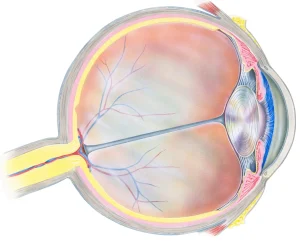 Sharp vision depends on light coming to a precise point on the retina. That precise point of focus is what you perceive as clear vision. When the cornea is too steep, too flat or unevenly curved, light focuses in the wrong place, causing short-sightedness, long-sightedness or astigmatism. Both PRK and LASIK remove a small amount of corneal tissue to reshape the corneal structure, correcting common vision problems by changing how the cornea bends light.
In our LASIK procedure, a femtosecond laser creates the flap, a technique known as bladeless LASIK. Once treatment is complete, the flap is closed and seals on its own, acting as a natural bandage over the treated area. With PRK, the surface layer grows back over several days, so there is no flap to heal.
Who Suits PRK, and Who Suits LASIK?
PRK tends to suit patients whose corneas are too thin for a flap, or whose work carries a risk of flap-related complications. LASIK tends to suit patients with adequate corneal thickness and a healthy eye surface, and it offers a more rapid visual recovery than PRK.
Because LASIK uses part of the cornea to form the flap, less tissue remains beneath it for reshaping. For this reason, surface treatment can suit thin corneas and eyes where a flap is unsuitable, even though recovery is slower. We may therefore prefer PRK when a flap is not advisable for your eyes or your work.
What Is Recovery Like After PRK and LASIK?
Most patients see better after laser eye surgery, but the pace of visual recovery differs. Vision is usually fairly comfortable the day after LASIK surgery, while PRK surgery needs at least a week of rest before normal activity.
LASIK Recovery
After LASIK, your eyes may feel slightly gritty or sore. For LASIK patients, this is usually only mild irritation with minimal discomfort, and it typically settles by the next day. Compared with PRK, LASIK offers a faster recovery and less discomfort, and with this more rapid recovery, you can often return to desk-based work within the week. At your aftercare appointments, you are given realistic timelines for your recovery time and return to usual activities.
PRK Recovery
PRK patients go through a longer recovery process. After the PRK procedure, a soft bandage contact lens is placed over your cornea to support the healing process, and you are given eye drops and instructions for your recovery. Many patients feel discomfort and light sensitivity for a few days, and vision may be blurred until the surface heals.
The bandage lens is removed once the surface has healed. After that, vision improves gradually, and it can take up to six months for your vision to fully stabilise.
PRK vs LASIK: What Risks Should You Weigh?
Both LASIK and PRK carry risks, including dry eye and infection. LASIK carries flap-related risks that PRK avoids, while PRK carries a risk of corneal haze, a cloudiness that can form as the surface heals. Individual outcomes vary, and some patients need a second treatment for over-correction or under-correction.
Dry eye is a common side effect of both procedures. Research shows that two months after laser eye surgery, dry eye symptoms affected 41.4% of eyes in a group of 778 patients. The rate was slightly higher after surface treatments such as PRK than after LASIK.
Flap complications are specific to LASIK, and they include wrinkles in the flap or a flap moving out of position. Creating a thin flap with a femtosecond laser has reduced several flap-related complications linked to older blade methods, although even advanced technology does not remove them completely.
How Does Your Eye Surgeon Choose Between the Two Procedures?
 Before either procedure, you have a thorough examination with your eye surgeon and the clinical team. This examination measures your corneal thickness, assesses the overall health of your corneal tissue, and checks your eye health for any eye disease or pre-existing dry eye.
Your eye surgeon also considers your age, whether your prescription has been stable for at least a year or two, and whether it falls within the treatable range. Conditions such as cataracts, corneal scarring or keratoconus, a cone-shaped cornea, may make laser surgery unsuitable.
When comparing PRK and LASIK, it may turn out that neither suits your eyes. In that case, lens-based vision correction may be considered, such as an implantable collamer lens placed inside the eye or refractive lens exchange.
Discuss PRK and LASIK With Dr Edward Roufail
PRK and LASIK differ in how they heal and in the risks they carry, so the choice between them needs to be made for your eyes specifically. Dr Edward Roufail is an experienced surgeon who performs PRK, LASIK and SMILE laser vision correction, as well as lens-based procedures, so your assessment can consider each of these options. The risks of your chosen procedure are discussed with you during the consent process. To arrange an assessment, please call us on (03) 9071 0180.
Frequently Asked Questions
Can I have PRK if I have already had LASIK?
In some cases, yes. PRK can be used after earlier laser eye surgery, including to treat some problems with a LASIK flap. Whether it suits you depends on how much corneal tissue remains.
Are both eyes treated on the same day with LASIK?
In most cases, yes. Both eyes are usually treated in the same LASIK session unless there is a clinical reason not to, which also means both eyes recover over the same period.
What prescriptions can PRK treat?
As a general guide, PRK can treat short-sightedness of up to -12.00 dioptres, long-sightedness of up to +6.00 dioptres, and astigmatism of up to -4.00 dioptres. Your exact suitability is confirmed at your first appointment.
Will I still need glasses after PRK or LASIK?
If you are under 40, you should not usually need glasses after surgery, although the amount of improved vision depends on your age and how stable your prescription is. From around 40, the lens inside the eye becomes more rigid and close-up vision changes, so you may need a different treatment for reading vision.
Do I need a referral for PRK or LASIK?
A referral is not required for a laser eye surgery consultation with Dr Roufail. Details of your previous prescriptions are still helpful, because they show how long your vision has been stable.
Any surgical or invasive procedure carries risks. Before proceeding, you should seek a second opinion from an appropriately qualified health practitioner.
References
https://ranzco.edu/home/patients/patient-information/
https://www.nature.com/articles/s41598-024-71604-y


Choosing the right vision correction treatment can feel overwhelming. With multiple options available, it is important to understand the differences Read more

Thinking about vision correction can feel exciting, until you hit the big question: the cost of LASIK surgery. Many patients Read more

If you have been thinking about vision correction, it is completely normal to ask: Does LASIK hurt? LASIK eye surgery Read more