

If you have noticed rings around headlights or streetlights since your laser surgery, that effect is known as a LASIK halo. It comes up often in the weeks after treatment, and few expect vision to be sharp in daylight yet ringed at night. There is a clear reason for it, and there are specific situations where it is worth mentioning at your review. Knowing which is which makes the first few months much easier to read. In this blog post, we cover what halos are, why they appear, how common they are, how long they typically last, and when to raise them.
Quick Overview
- A halo is a ring or glow around a bright light source, seen mainly in dim light when the pupil is wider.
- It happens because the treated cornea scatters light slightly differently from the untreated area around it.
- Halos are common in the first months after surgery and tend to ease as the eye heals and the brain adapts.
- Persistent or worsening halos beyond six months are worth investigating.
Halo covers several different effects, and knowing which one you have is where this begins.
What Do Halos After LASIK Actually Look Like?
A halo is a soft ring or wash of light around a bright object. Bright lights against a dark background are what set it off, and the effect is strongest when the surrounding light is low. Headlights, streetlights, traffic signals and phone screens in a dark room are the usual triggers, and bright objects of any kind can do the same at night.
Patients often use other words for related effects. Starbursts are spikes of light radiating outwards, like a camera lens flare. Glare is a general wash of brightness that reduces contrast, making it harder to pick out detail near a light source. Light scatter is the underlying physical process behind all three.
These are night vision symptoms, not daytime ones. In bright conditions, the pupil constricts, so light entering the eye passes mainly through the centre of the treated zone. In low light conditions, the pupil widens, and more peripheral light enters through the edges of the cornea, where the optical properties differ.
Why Halos Happen After LASIK
LASIK reshapes the central cornea to correct refractive errors. Reshaping any curved surface changes how light bends across it, and the change is not perfectly uniform from centre to edge.
 Two things follow from this. First, the treated zone has a boundary. Light passing through the transition between treated and untreated cornea refracts slightly differently. In dim light, when the pupil is wider, more of that light reaches the retina. Second, the procedure increases what are called higher-order aberrations, which are subtle optical imperfections that glasses cannot correct. Ordinary refractive errors such as short-sightedness are simple aberrations. Coma and spherical aberration are more complex ones, and they are what produce a smear or ring rather than a clean point of light.
Early on, the corneal flap and corneal surface are also still settling. Minor swelling and surface irregularity add their own light scatter, and this component eases as the eyes heal. That is why halos tend to be strongest in the first few weeks and quieter by the second month.
How Common Are Halos After LASIK?
Night vision disturbances are a recognised side effect of laser vision correction, not a rare complication. A study measuring patient-reported visual disturbances at three months found that 57.4% of patients reported halos at least occasionally.
That study followed 95 patients through PRK, LASIK or SMILE. Fluctuating vision was reported by 70.5% and glare by 66.3%, so halos sat third on the list. Reporting a symptom occasionally is not the same as being troubled by it, and the same study measured severity and bother separately, with lower figures for both.
The researchers also found something relevant to night driving. Patients reporting halos had measurably worse ability to identify moving objects than those without, and in the LASIK subgroup specifically the difference reached significance at both test speeds. Their advice was that patients bothered by these symptoms should take care with driving, and with contact sports or anything involving fast movement.
How Long Do LASIK Halos Last?
Halos are at their strongest in the first few weeks, then ease over the following months. Visual disturbances after laser refractive surgery are gradually alleviated over long-term follow-up.
Three separate processes contribute to that improvement. The corneal surface smooths as healing progresses. The tear film stabilises, which reduces scatter. And your visual system gradually learns to filter the new pattern, a process called neural adaptation. A halo you noticed constantly in week two may barely register by month four.
As a general guide, vision after laser surgery can take up to six months to stabilise. Mild halos still present at three months are completely normal at that point in the healing process, and often continue to settle. Symptoms that have not changed at all by six months should be assessed.
Dry Eye and Its Role in Night Vision
Dry eye is worth separating out, because it is the one contributor that can be treated directly.
The procedure interrupts corneal nerves that signal tear production, so tear output drops for a period. A less stable tear film means a less smooth optical surface, and an uneven surface scatters light. Much of the fluctuating vision and glare reported after surgery traces back to this tear film disruption.
The practical implication is encouraging. Lubricating eye drops smooth the surface, and for some patients that alone reduces how noticeable halos are, particularly late in the day when dryness accumulates. Technique matters as much as frequency. Wash your hands, draw the lower lid down and let one drop fall into the pocket that forms, without touching your lashes. Preservative-free artificial tears are generally favoured when drops are used several times a day.
What Raises the Risk of Night Vision Symptoms?
Several factors are associated with more noticeable halos, and screening before surgery is where they are identified.
- Pupil size in dim light. Very large pupils have long been considered a factor, on the reasoning that dilated pupils can extend past the treated zone. The evidence on this is not settled. Modern laser technology treats larger optical zones than earlier generations, which narrows the mismatch.
- The size of the correction. Larger corrections mean more corneal tissue reshaped and a greater change in the corneal profile.
- Pre-existing dry eye. Tear instability before surgery tends to persist or worsen afterwards, and preoperative screening looks for it.
- Residual refractive error. An eye left slightly under- or overcorrected has an uncorrected focusing error of its own, which adds to the effect.
- Corneal thickness. Thinner corneas limit how much tissue can be reshaped, which affects which laser procedure and which treatment zone are available to you.
- Irregular corneas. Surface irregularity before surgery affects how predictably light will be focused afterwards.
None of these rules out treatment. What they change is the discussion beforehand, and whether a different procedure suits your eyes better.
When Halos Need Medical Attention
Nearly all of what is described above is expected and settles on its own. A smaller set of patterns should prompt an appointment.
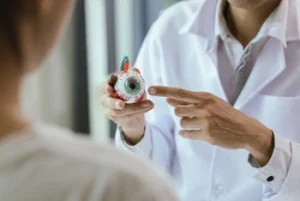 Raise it if halos are worsening rather than easing. Raise it too if they appear or intensify months after surgery having previously settled, or if they arrive alongside blurred vision that a new prescription does not fix. Those combinations can point to something other than normal healing. One pattern to rule out is a cornea that is changing shape after surgery. Its symptoms include increased light sensitivity, glare and halos, alongside a surface growing progressively more irregular.
Persistent halos that are affecting your driving or your work also warrant assessment on their own terms, even if nothing is structurally wrong. Note when the symptoms are worst and what you were doing at the time, because that pattern helps narrow the cause. Corneal imaging, wavefront measurement and tear film assessment together usually identify which of the possible contributors is responsible. Once the cause is clear, the options range from treating dry eye more intensively to correcting a residual refractive error.
Book a LASIK Assessment at Our Clinic
Night vision symptoms are easier to interpret when someone has your preoperative measurements to compare against, which is why pupil size, corneal shape and tear film are all assessed before surgery. Reviewing them afterwards separates ordinary healing from a change that needs acting on, and your assessment is where realistic expectations about night vision get set. Dr Edward Roufail is an ophthalmologist who performs LASIK alongside other laser vision correction procedures, and he assesses corneal shape and visual quality at each post-operative review. Whether halos are troubling you now, or you are weighing up LASIK and want the night vision side explained first, we are glad to help. To arrange a consultation at our eye clinic, please call us on (03) 9071 0180.
Frequently Asked Questions
Should I avoid driving at night in the first few weeks after LASIK?
Take a cautious approach until you have tested your night vision somewhere quiet. Halos reduce your ability to pick out moving objects, which is exactly the demand night driving places on your eyes. Start with familiar roads in early evening, not a motorway in the dark, and raise it at your review if you feel unsafe.
Do halos mean something has gone wrong with my LASIK?
Not on their own, and in the early months they are an expected part of healing, not a sign of a problem. What matters is the direction they are heading. Halos that are easing week by week are behaving as expected, while halos that are intensifying are worth reporting.
Can glasses or contact lenses correct halos?
Not usually, because higher-order aberrations are the type of optical imperfection that spectacle lenses cannot address. Where a residual refractive error is contributing, correcting that may help. Rigid contact lenses are occasionally used for significant surface irregularity, though that applies to a narrow set of cases.
Will halos come back later in life?
Halos from LASIK itself tend not to return once they have settled. Other causes can produce similar symptoms decades later, cataract being the common one, and those are unrelated to your laser treatment. If rings around lights reappear years afterwards, have your eyes examined before assuming a connection.
Are halos more likely after LASIK than after SMILE or PRK?
All three can produce them, and halos have been reported after each. The clearest link between halos and reduced moving-object vision has been seen after LASIK, though the groups compared were small. Which procedure suits you comes down to your corneal measurements, not to halo risk alone.
Any surgical or invasive procedure carries risks. Before proceeding, you should seek a second opinion from an appropriately qualified health practitioner.
References
https://www.dovepress.com/corneal-collagen-crosslinking-for-ectasia-after-refractive-surgery-a-s-peer-reviewed-fulltext-article-OPTH
https://www.reviewofophthalmology.com/article/a-review-of-photorefractive-keratectomy


Choosing the right vision correction treatment can feel overwhelming. With multiple options available, it is important to understand the differences Read more

Thinking about vision correction can feel exciting, until you hit the big question: the cost of LASIK surgery. Many patients Read more

If you have been thinking about vision correction, it is completely normal to ask: Does LASIK hurt? LASIK eye surgery Read more